The History and Origins of "Would You Rather?" — From Ancient Greece to TikTok
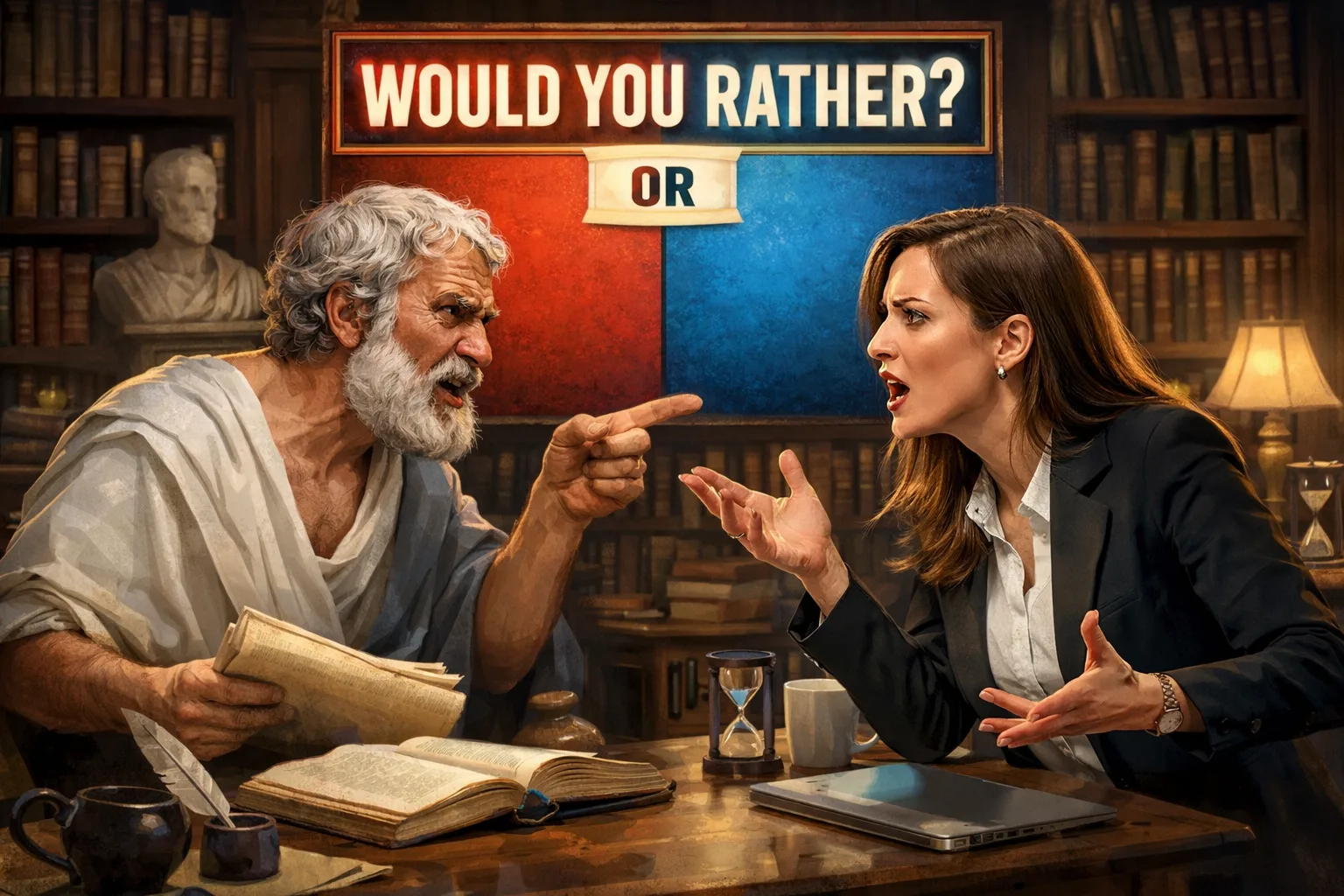
Look, I'll be honest with you. When I sat down to trace the history of "Would You Rather?", I half expected to find it was invented by a bored university student in about 1997. Perhaps someone called Dave, three pints deep at a pub quiz that had gone off the rails.
I was wrong. Quite spectacularly wrong, as it happens.
The roots of this deceptively simple game stretch back — and I do mean back — to some of the most celebrated minds in human history. Which is either a wonderful testament to the enduring power of hypothetical thinking, or proof that humans have always been fundamentally incapable of sitting quietly without pestering one another with impossible questions. Probably both, if we're being truthful about it.
Blame the Greeks (We Usually Do)
You can't discuss the intellectual heritage of "Would You Rather?" without mentioning Socrates, and I realise that sentence makes me sound like the worst sort of dinner party bore. But stay with me, because there's a genuine throughline here.
Socrates — the Athenian philosopher, not the Brazilian footballer — spent his entire career asking people uncomfortable either/or questions. His whole method, later formalised as the Socratic Method by his student Plato, revolved around presenting someone with two options and then watching them squirm their way towards a deeper truth. If that isn't the basic architecture of "Would you rather fight one horse-sized duck or a hundred duck-sized horses?", I don't know what is. Admittedly, Socrates was more concerned with questions about piety and the nature of justice than about whether you'd prefer to have fingers for toes or toes for fingers. But the underlying mechanism — force a binary choice and see what it reveals about a person — is remarkably similar.
His most famous example is probably the Euthyphro dilemma, recorded by Plato around 399 BC, in which Socrates essentially corners a man named Euthyphro with a particularly devastating "Would you rather?" about the nature of holiness. Poor Euthyphro eventually just walked off, claiming he had somewhere else to be. Which, to be fair, is also how most modern rounds of the game end when someone asks whether you'd rather eat a spider every morning or never use the internet again.
Campfires, Parlour Games, and the Long Middle Bit
Between ancient Athens and the modern era, the tradition of hypothetical dilemma games never truly disappeared — it just went a bit quiet, like a well-mannered party guest who excuses himself for several centuries.
Storytelling traditions across cultures regularly employed the device. Medieval morality plays posed binary ethical dilemmas to their audiences. Salon culture in eighteenth-century France delighted in posing provocative "what if" scenarios to spark debate among the aristocracy, presumably between courses of something implausibly rich.
By the Victorian era, parlour games had become serious business — and I use the word "serious" with considerable irony, because these were fundamentally designed to alleviate the crushing boredom of an evening without television. Games involving forced choices between two scenarios were a popular fixture, though they tended towards the morally improving rather than the gloriously absurd questions we enjoy today.
The point is this: the human appetite for being forced to choose between two things, ideally while other people watch and judge, appears to be genuinely hardwired. We've been doing it, in one form or another, since we first gathered around fires and someone inevitably asked, "Right, but would you rather fight the sabre-tooth tiger or the mammoth?"
The Twentieth Century: From Psychology Labs to Sleepovers
Here's where things get properly interesting, and by "interesting" I mean "documented in academic journals, which is the dullest form of interesting but the most reliable."
In the 1960s, "Would you rather" questions started appearing in psychological studies of motivation. Researchers used them as a standardised way to assess preferences, values, and decision-making tendencies. Participants would be presented with two fixed options and asked to choose. It was simple, elegant, and it actually worked remarkably well at revealing things about personality that more sophisticated instruments sometimes missed.
By the 1970s, the format had migrated into studies of children's behaviour, which makes perfect sense when you think about it. Children are naturally brilliant at this game because they haven't yet developed the adult skill of saying "Well, it depends on the context" — that maddening hedge which ruins every good hypothetical.
Through the 1980s and 1990s, the game properly embedded itself in popular culture. It became a staple of sleepovers, camping trips, long car journeys, and any social gathering where people were trapped together for extended periods with nothing but their imaginations for entertainment. The questions evolved too. The 1960s might have given us "Would you rather be a hippie or an astronaut?" — reflecting the genuine cultural tensions of the era — while the 1990s served up "Would you rather have a Tamagotchi or a Furby?", which, with the benefit of hindsight, was actually a question about which small plastic object you'd like to eventually abandon in a drawer.
Going Commercial: The Board Game Years
The early 2000s saw the inevitable commercialisation of the concept, because this is what happens to everything enjoyable — someone puts it in a box and sells it back to you.
Zobmondo Entertainment released the "Would You Rather?" board game in 2003, complete with 1,500 pre-written questions divided into categories like pain, embarrassment, ethics, and — rather alarmingly — ingestion. The game introduced a competitive element: players had to guess which option the majority would prefer, adding a layer of social psychology to what had previously been a purely chaotic free-for-all.
Multiple editions followed, including a "Twisted, Sick and Wrong" version for people who felt the standard edition was too gentle. Various family-friendly editions appeared as well, because someone at the company presumably had the good sense to realise that not every "Would you rather?" question is suitable for the Christmas dinner table.
The board game was a modest commercial success, but its real achievement was legitimising the game as an actual thing — something with rules and structure, rather than just something that happened spontaneously between friends after too much wine.
The Digital Age: Social Media, Apps, and Going Viral
Then came the internet, and everything changed. As it does.
The game's format turned out to be almost criminally well-suited to social media. It's short, shareable, and inherently designed to provoke a response. You simply cannot read "Would you rather have the ability to fly or be invisible?" without forming an opinion, and once you've formed an opinion, you feel an almost primal need to share it and discover what everyone else thinks. It's engagement bait of the most elegant kind.
By the early 2010s, apps dedicated to the game began appearing. The "Either" app allowed users to poll each other on their preferences and display results in real time, turning what had been a private conversation into a mass participation exercise. Screenshots of particularly divisive results circulated on Reddit and other platforms, often generating thousands of heated comments from people who really, truly needed the world to understand why being invisible was obviously the correct choice.
Social media platforms like Instagram, TikTok, and Snapchat adopted the format enthusiastically. Instagram's poll stickers might as well have been designed specifically for "Would you rather?" questions. TikTok creators built entire channels around the concept, often filming their friends' reactions to increasingly outlandish scenarios. The game, which had survived for millennia through oral tradition, adapted to the digital age with an ease that frankly put most traditional institutions to shame.
In 2011, the Irish comedian Graham Norton even hosted a television show based on the game for BBC America, featuring celebrity panellists competing for points by answering questions. Because of course he did. Norton's entire career has essentially been an extended game of "Would you rather?" with famous people and a generous wine budget.
Family Guy, Snapchat, and Cultural Moments
The game cropped up in popular culture with increasing frequency. Family Guy regularly featured characters playing it, typically as a vehicle for the show's trademark outrageous scenarios. It became shorthand for a certain type of comedy — transgressive, hypothetical, and deeply committed to making everyone uncomfortable.
Not every cultural moment was positive, mind you. In 2018, Snapchat ran an advertisement framed as a "Would you rather?" question involving real people and a sensitive domestic violence case. The ad was pulled almost immediately, but the controversy served as a useful reminder that while the game's format is inherently playful, the content requires a modicum of taste and judgment — qualities not always abundant in Silicon Valley advertising departments.
Why It Works: The Psychology of the Forced Choice
I promised you history, not a psychology lecture, but it's worth briefly addressing why this particular game has proven so enduring. Because surviving from ancient Athens to TikTok is no mean feat for any form of entertainment.
The forced binary choice does something peculiar to the human brain. It eliminates the comfortable middle ground where most of us prefer to live. You must commit. You must reveal something about your priorities, your fears, your values. There's no abstaining, no "I'd have to think about it," no diplomatic non-answer. The game strips away social niceties and forces a kind of honesty that's genuinely quite rare in everyday conversation.
Psychologists have noted that the game works on multiple levels simultaneously. On the surface, it's entertainment — often very funny entertainment. But underneath, it's a remarkably efficient tool for understanding how people think. Their answers reveal their risk tolerance, their moral framework, their capacity for imagination, and often their sense of humour. All from a question that takes five seconds to ask.
This is precisely why it's been adopted so enthusiastically in education, team-building, therapy, and language learning. Teachers use it to get quiet students talking. Corporate trainers use it to break the ice at conferences. Therapists use it to explore values with clients who might struggle with more direct questioning. ESL instructors love it because it demands conversation without requiring specialist vocabulary.
So Where Did It Come From? The Honest Answer
If you've read this far hoping for a neat origin story — a specific inventor, a particular date, a definitive "first ever" question — I'm afraid I must disappoint you. The truthful answer is that nobody invented "Would you rather?" in the same way that nobody invented the conversation, the joke, or the argument. It emerged, gradually and organically, from the basic human impulse to pose hypothetical dilemmas and see what happens.
What we can say is this: the concept of forced binary choices as a tool for exploring truth is at least 2,400 years old, traceable to the philosophical traditions of ancient Greece. The game as a recognisable social activity took shape during the twentieth century, first in academic research and then in popular culture. The commercial product dates to the early 2000s. And the cultural phenomenon — the version that exists on every social media platform and in every classroom and at every sleepover — is really a product of the digital age.
It's been quite the journey, from Socrates interrogating Athenians about the nature of holiness to teenagers on TikTok debating whether they'd rather have spaghetti for hair or sweat maple syrup. The philosopher in me wants to say it's all part of the same grand tradition of human inquiry.
The realist in me suspects Socrates would have been absolutely insufferable on social media.
What's your favourite "Would you rather?" question? Whether you lean towards the philosophical or the ridiculous — and frankly, the best ones are both — there's something wonderful about a game that's been making people argue, laugh, and think for thousands of years. Long may it continue.